AI for Beginners: Launch Your Learning Journey | AI Revolution Daily
Santhosh
1/1/20256 min read
Start Your AI Journey
1. Conceptual Groundwork:
Artificial Intelligence (AI): AI is the broader concept of machines being able to carry out tasks in a way that we would consider “smart”. It encompasses anything from Google's search algorithms to IBM's Watson to autonomous weapons.
Machine Learning (ML): ML is a subset of AI. It's the study of getting computers to act without being explicitly programmed. In the past decade, ML has given us self-driving cars, practical speech recognition, effective web search, and a vastly improved understanding of the human genome.
Deep Learning (DL): DL is a subset of ML. It uses a model of computing inspired by the structure of the brain, called artificial neural networks. Deep learning can interpret large amounts of data such as images, sound, and text.
2. Mathematics:
Linear Algebra: It's fundamental to AI and involves vectors, matrices, and linear transformations. It's key in understanding how algorithms work under the hood.
Probability and Statistics: These are critical for making predictions and decisions under uncertainty, which is a common scenario in AI. Concepts like Bayesian thinking, distributions, and statistical analysis are vital.
Calculus: It’s essential for building most AI models. Understanding derivatives and integrals is crucial for optimization problems in machine learning and understanding how algorithms minimize error and improve accuracy.
3.Programming Knowledge:
1. Python:
Python is favored in AI due to its simplicity and readability, along with a strong community, and the vast selection of libraries and frameworks.
Libraries like TensorFlow and PyTorch: They are used for building models in deep learning. TensorFlow is known for its powerful computational abilities, while PyTorch offers ease of use and simplicity for prototypes and research.
Scikit-learn: This is used for traditional machine learning algorithms, which include classification, regression, clustering, and dimensionality reduction.
2. R:
R is particularly strong in statistics and data visualization. It’s widely used in academia and research.
It has packages like caret, nnet, and randomForest that are used for various machine learning tasks.
R is preferred for data manipulation, statistical modeling, and visualization.
4.Courses to Master AI:
Online Courses with Links:
Coursera - Andrew Ng's Machine Learning and Deep Learning Specialization:
Machine Learning Course: Coursera - Machine Learning by Andrew Ng
Deep Learning Specialization: Coursera - Deep Learning Specialization
edX - Offerings from MIT and Harvard:
MIT's AI Course: edX - Artificial Intelligence
Harvard's Data Science: edX - Harvard Data Science
Udacity - Nanodegree programs in AI and machine learning:
AI Nanodegree: Udacity - Artificial Intelligence Nanodegree
Machine Learning Nanodegree: Udacity - Machine Learning Nanodegree
DataCamp - Data Science and Machine Learning:
DataCamp Courses: DataCamp
5.Get Practical
Online Tutorials: Use platforms like Codecademy or freeCodeCamp to get hands-on coding experience.
Projects: Apply what you’ve learned by working on small projects, like building a simple chatbot or a recommendation system.
6.Formal Education
Undergraduate Degree: In computer science, mathematics, or related fields.
Graduate Programs: Specialized master's or Ph.D. programs in AI or machine learning.
7.Time Commitment:
Casual Learning: Spending an hour a day could get you a good overview in several months.
Intensive Courses: Bootcamps and online courses often require 10-20 hours a week and last for several months to a year.
Degree Programs: Bachelor’s degrees take about 4 years, while master’s programs take 1-2 years full-time.
8.Opportunities in Different Industries:
Tech and Software
Development: Building AI-driven applications.
Research: Innovating new AI methodologies and technologies.
Healthcare
Diagnostics: AI for analyzing medical images or predicting patient diagnoses.
Personalized Medicine: Tailoring treatments to individual genetic profiles.
Finance
Algorithmic Trading: Using AI to make trading decisions.
Fraud Detection: Identifying suspicious activities.
Automotive
Self-driving Cars: AI systems to automate vehicle operation.
Manufacturing
Automation: Using robots for tasks like assembly and inspection.
Entertainment
Content Creation: AI in music generation, game development, and film.
9.Impact on Sectors:
AI is poised to transform virtually every industry. In healthcare, it can lead to earlier and more accurate diagnoses. In finance, AI can streamline processes and enhance customer service. Manufacturing can see increased efficiency through automation. The impact is vast and has the potential to revolutionize productivity, efficiency, and creativity.
10.AI and Job Disruption:
High Risk: Jobs that involve routine tasks, such as data entry, bookkeeping, and simple customer service, are more likely to be automated.
Moderate Risk: Roles that require a mix of routine tasks and problem-solving, like middle management, could see AI as a tool to augment their work.
Low Risk: Creative professions, jobs requiring human interaction like healthcare, or those needing high-level strategic decision-making are less likely to be affected.
Professionals can safeguard their careers by up skilling, focusing on areas where human skills are irreplaceable, and staying abreast of AI developments to understand how it can be a tool rather than a replacement.
Conclusion:
Starting to learn AI from scratch requires dedication to understanding the underlying principles, getting practical with programming, and constantly learning and adapting. The opportunities in AI are vast and cross-disciplinary, impacting numerous sectors. While there are concerns about job displacement, AI also brings the potential for job creation, and a future where AI and human intelligence work in tandem to solve some of the world's most pressing problems. For those embarking on this learning journey, the future is bright with the promise of innovation and growth.


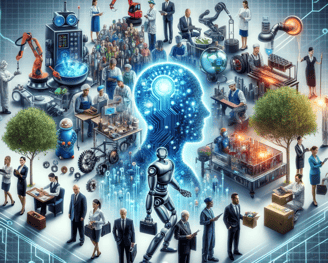
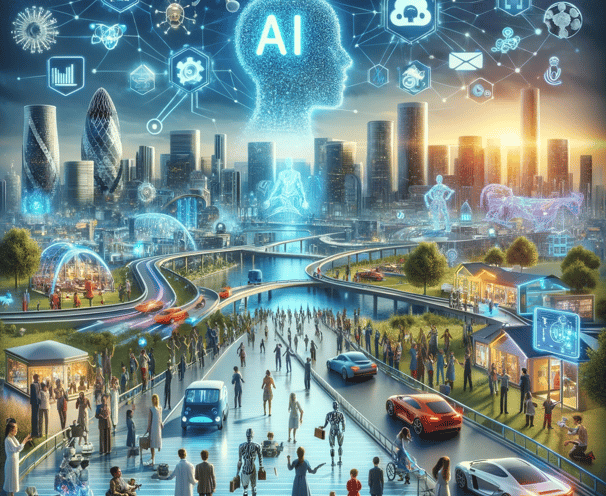
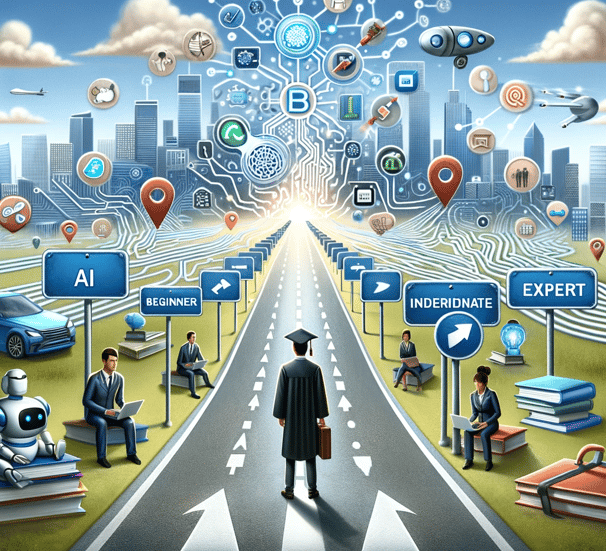
Artificial Intelligence (AI) is set to have a transformative impact across multiple industries and sectors. Here are some key points detailing the potential effects:
Healthcare:
Diagnostics: AI algorithms can analyze medical images with greater accuracy and speed than human practitioners.
Personalized Medicine: AI can tailor treatment plans to individual patients based on their genetic makeup.
Drug Discovery: AI can expedite the process of discovering new drugs by predicting how different drugs will react in the body.
Finance:
Fraud Detection: AI systems can identify potentially fraudulent transactions with higher accuracy and quicker response times.
Algorithmic Trading: AI can analyze market data to execute trades at the optimal time.
Personalized Banking: Banks use AI to provide personalized financial advice to customers.
Automotive:
Autonomous Vehicles: AI is central to the development of self-driving cars, managing everything from navigation to obstacle avoidance.
Supply Chain Management: AI optimizes supply chain logistics, predicting demand and automating inventory management.
Retail:
Customer Service: AI-powered chatbots provide customer support and personalized shopping advice.
Inventory Management: Predictive analytics powered by AI can help retailers efficiently manage stock levels.
Personalized Experiences: AI can tailor product recommendations to individual consumer behaviors and preferences.
Manufacturing:
Predictive Maintenance: AI predicts when machines are likely to fail or need maintenance, thus reducing downtime.
Quality Control: AI systems can inspect and detect defects in products with high precision.
Smart Production: AI enables adaptable production processes that can respond to changes in demand in real time.
Agriculture:
Crop Monitoring and Analysis: AI-driven drones can monitor crop health, soil conditions, and more, providing data to optimize farming practices.
Precision Farming: AI helps in making farming more precise and controlled when it comes to growing crops and raising livestock.
Energy:
Smart Grid Management: AI can predict energy demand and adjust the supply accordingly.
Renewable Energy Optimization: AI optimizes the operation of renewable energy sources, such as wind turbines and solar panels.
Education:
Personalized Learning: AI tailors educational experiences to individual student needs, pacing, and learning preferences.
Automated Administration: AI can automate administrative tasks, allowing educational institutions to be more efficient.
Entertainment:
Content Creation: AI can generate music, write stories, and even help in video game development.
User Experience: AI can personalize content recommendations on streaming services based on viewing history.
Security:
Surveillance: AI enhances security monitoring by identifying threats more efficiently than human surveillance can.
Cybersecurity: AI systems can detect and defend against sophisticated cyber attacks.
Telecommunications:
Network Optimization: AI optimizes network traffic routing to improve service and reduce congestion.
Predictive Maintenance: AI anticipates equipment failures and network outages before they occur.
Legal:
Document Analysis: AI can analyze legal documents to assist in research and case preparation.
Predictive Analysis: AI predicts legal outcomes based on historical data to assist in strategy development.
Real Estate:
Property Analysis: AI analyzes market data to predict property trends and valuations.
Virtual Tours: AI-powered virtual assistants can provide guided tours of properties.